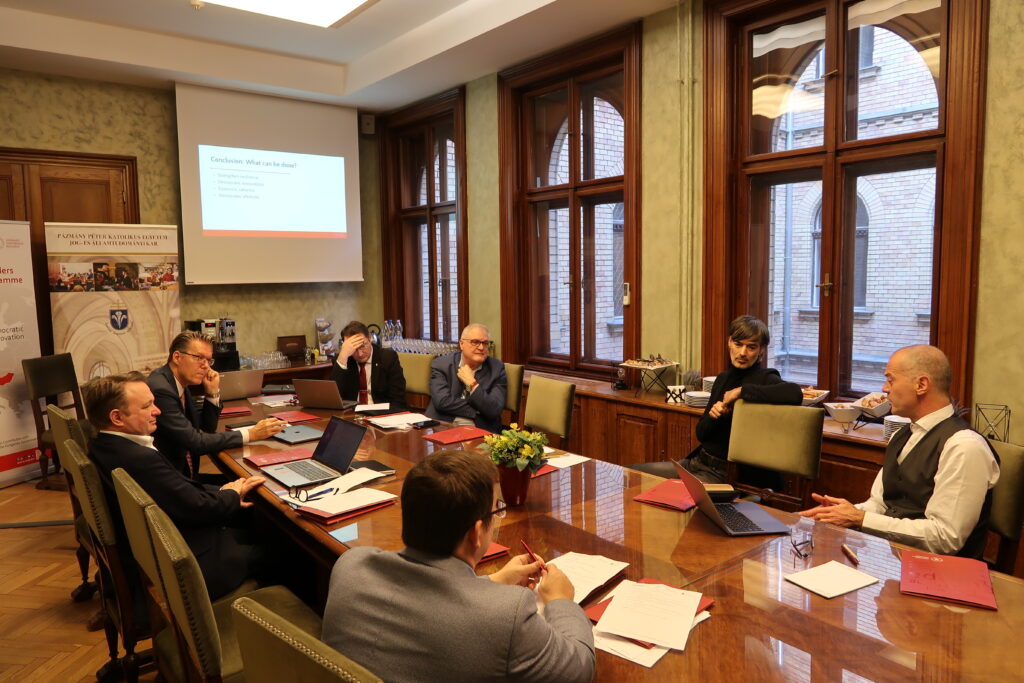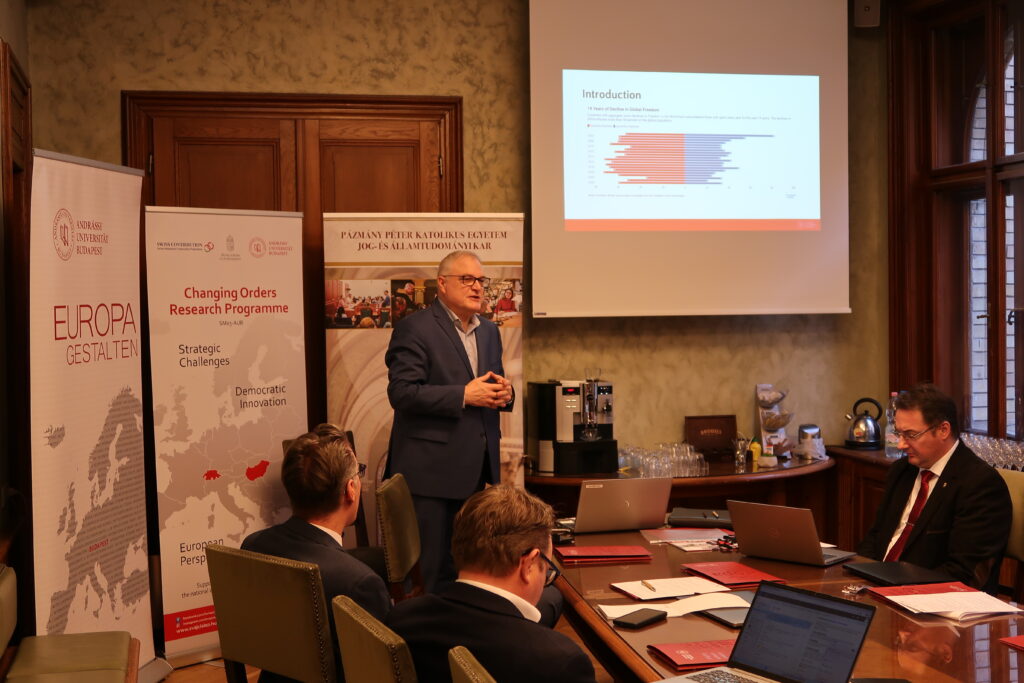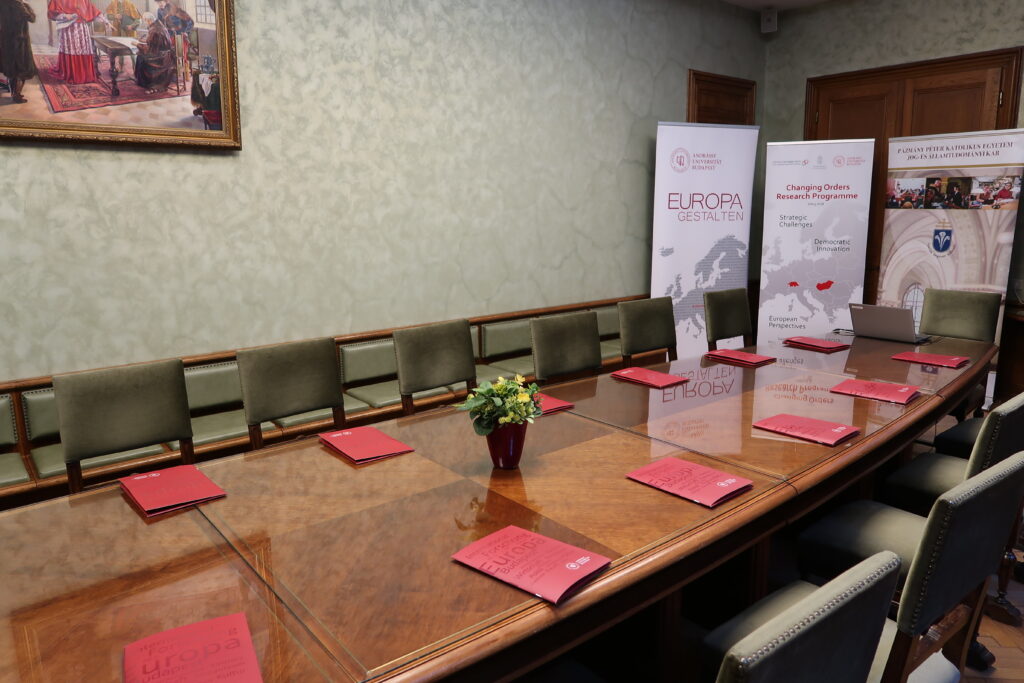
Divided into two panels, new concepts of national-level political innovations by different specialists from different countries. The conference was organized by rector Prof. Dr. Zoltán Tibor Pállinger and the Pázmány Péter Catholic University.
The conference took place at the Pázmány Péter Catholic University Budapest as part of the „Changing Orders Research Programme.“
Dr. László Komáromi from the Pázmány Péter Catholic University and Zoltán Pállinger opened the conference by thanking all participants for coming and the Swiss-Hungarian Cooperation Programme for making conferences like this possible. They also marked out the long standing cooperation between Andrássy University Pázmány Péter Catholic University.
Komáromi stated that not only regimes but also democracies can have innovations. Pállinger added this conference is not only about these innovations, but also on how politicians use or misuse these tools.
Panel 1: Conceptional Foundations:
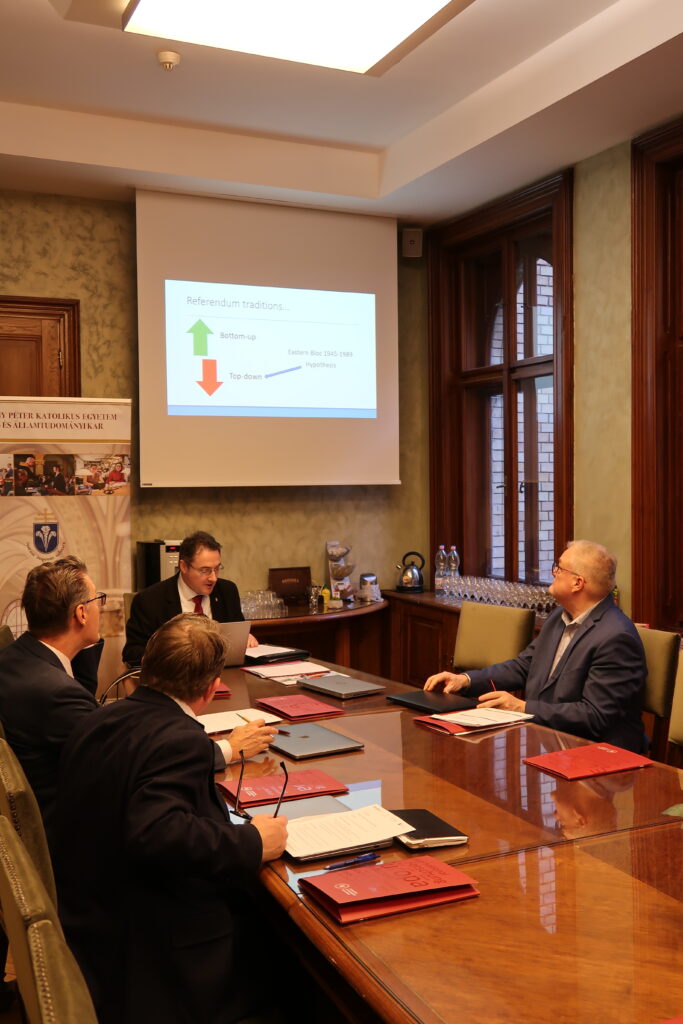
The first speaker of the first panel was László Komáromi himself. He looked back at how referendums were held in the so called former eastern block. He stated the difference between top down and bottom up referendums, and that top down referendums lead the way. He explained that the Stalin-Soviet Constitution was the blue print for different referendums held in the “eastern block”. Overall there have been referendums to consolidate emerging communist power, against rearmament and reintegration of Germany into the Western alliance, the ratification of new constitutions, later to weakening communist regimes to strengthen the regimes position and as a direct democratic instrument in the political transformation. He concludes that there were no bottom-up referendums till 1989. At the end the participants debated if top-down referendums are necessarily a misuse.
The second speaker of the first panel was Dragan Prole from the University of Novi Sad. He talked about democracy beyond political parties. He divided his talk into three parts. At first he talked about the situation in Serbia in the past few months, especially after the train station tragedy in Novi Sad. Then he described how the people went from shock to, to moaning, to anger in the process afterwards and that what followed were the building of structures especially in schools and universities to hold people accountable. The special thing about that was, that they had no leader at the top. At the end he described the difference between epic and tragic community heroes and what their characteristics are, especially in times of crisis.
After that Zoltán Pállinger gave his speech on „Subverting Democratic Innovations: Autocratic Appropriation of Democratic Instruments”. He started his talk stating that global freedom is in decline and that democracy is in crisis. He said that elections itself don’t provide the necessary democratic legitimacy for democratic governance, but this should not mean the end of democracy, as democratic innovations can be key to that. After that he marked out political innovations which were democratic but are weaponized by autocrats and therefore became autocratic innovations within democracies. At the end he proposed some ideas on what needs to be done to fight against this trend such as economical reforms, more democratic innovations, strengthening resilience and forming democratic alliances.
The last talk from the first panel came from Dániel Oross from ELTE University. He focused on Hungary and presented his research on „How Voters, Party Members, and Politicians See Deliberation in Hungary”. He started by stating that deliberation is a key factor of antidemocratic movements. He said that the reigning party is realizing they could lose the majority and started a national consolation to get to know the real opinion of voters, which therefore became an autocratic tool. He told that some democratic innovations are tested in some big cities in Hungary. Then Oross showed his research where he asked voters, party members and parliamentarians if democratic innovations could have a chance in Hungary. The outcome of approval was different from quote to quote and led to the discussion on possible future scenarios in Hungary.
Panel 2: Political Innovations
Csaba Madarász started the second panel by introducing a new eID system in the EU, designed to replace the old eIDAS framework. He explained that the previous system failed because creating national eIDs was voluntary, which led to inconsistent recognition across member states, technical difficulties, and very limited adoption in the private sector. The proposed solution is the European Digital Identity Wallet, which connects national digital identities with verified personal attributes while giving individuals full control over what data they share and with whom. From a democratic perspective, having a single EU-wide standard and trusted credentials could influence processes like petitions, referendums, and especially opinion polling. Instead of unreliable self-reported data, researchers could request verified attributes. Madarász concluded with a hypothetical idea: a digital marketplace where people could consent to share specific verified data with organizations in exchange for compensation.
In his presentation, Máté Szabó explored the role of the ombudsman and the “families” of their institutions across Europe. He emphasized that ombudsmen operate through professional oversight and investigative powers rather than enforcement, which ensures impartiality and neutrality. Szabó then introduced the concept of familiarism, meaning that groups of institutions are connected by shared political cultures, enabling broader communication and consultation. He outlined several European ombudsman families: the Scandinavian–Baltic–Greek–Icelandic group; the Spanish and French family with branches beyond Europe; and the Central-Eastern European group including Poland, Hungary, the Czech and Slovak republics, and the post-Yugoslav Balkans. He also mentioned “orphanage” states like Germany and Switzerland, which lack an ombudsman. As part of the International Ombudsman Institution founded in 1978, these bodies link to UN human rights work—hence China’s exclusion. Szabó described the ombudsman as a marker of democratic development and discussed post-war evolution, including failed or pseudo models in Turkey and Belarus. He concluded that current geopolitical shifts (Brexit, the war in Ukraine) may reshape these families but still influence EU law interpretation.
The third speaker of the second panel was Melani Barlai with her research about „Training Democracy: Electoral Integrity and the Institutionalization of Poll Worker Education in Europe”. She started her talk on poll workers by stating how important proper training is for them. She explained that elections as the procedural core of representative democracy depend on institutional microfoundations for their integrity and poll workers are the key to that. She further presented studies where 31 countries were coded by what they teach poll workers, what they teach them and who they are teaching. At the end Barlai looked at Hungary, where she stated that poll workers are not taught properly what their role is.
Then Uwe Serdült held his talk on „Democratizing Election Campaign Financing with the Help of a Voucher System”. He explained that violating the rules on campaign funding is not an anomaly but the norm. To address this issue, he presented a voucher system for campaign funding. He showed the example of the city of Seattle in the United States, where a voucher system was introduced in 2017, where every voter got vouchers that they could distribute among all political parties for their campaigns. With a voucher system, funding is more equally distributed between all political actors. It also has the advantage that more people are reached by whatever vote is on the line. His studies still show that the biggest political parties will still get the most funding, but many voters will also distribute their vouchers to more political parties. He stated that the system still has many open questions, for example economical or legal questions, but in a small sample size it shows that people are more willing towards democratic participation.
The final speaker was Arne Pautsch from Hochschule of applied science Ludwigsburg. He presented the concept of citizen assembly, which was used in Germany for the first time. He explained that the group of chosen citizens came together over a long time period to discuss the topic of food and nutrition. The participants met regularly in online meetings and in presence. The assembly worked out a short catalogue of concrete recommendations, which were presented to the German parliament. At the end he came to the conclusion that that was a missed opportunity for Germany, because the parliament was shown this “citizens report”, but at the end they did not implement any of those because the parliament did not take them seriously. Pautsch said that there were different reasons for that. Even though the process was scientifically evaluated and found to be effective, it lacked legal framework from the beginning. In the following discussion the participants searched for possible ways to make citizen assemblies work.At the end of the last panel Zoltán Pállinger and László Komáromi thanked all participants for their talks and new ideas on democratic innovation. They said in the following year they will come together again as part of this conference series to discuss democratic innovations on sub-national and local level. They also mentioned that a publication is planned to bring all the presentations together in written form to be able to read them at a later stage.